Legend has it the Delphic oracle told Apollo,
“The radish is worth its weight in lead, the beet its weight in silver, and the horseradish its weight in gold.”
There are very few things in this world that can beat the nasal-passage clearing, palate-rousing flavour of the knobbly root.
Whilst horseradish has been used worldwide for thousands of years, it is prized for its medicinal and gastronomic qualities, and bears a very intriguing history.
This root is a cruciferous vegetable, part of the Brassica genus of plants, alongside mustard, wasabi, cabbage, brussels sprouts, kale and more, and contains multiple compounds that may provide health benefits, including antibacterial and anticancer effects.
Horseradish has been used for centuries as an aphrodisiac, to treat rheumatism, and a flavourful accompaniment for most dishes.
So, how did the name ‘horseradish’ come about? Well, it is said that this perennial plant was cultivated in Greece and used both as a rub to treat lower back pain and as an aphrodisiac. From there it spread from east to west, with England being introduced to the root via Germany. The Germans called it “meerrettich” (sea radish) as it grew by the sea. It is believed that the English mispronounced the German word “meer”, and mistook the word to be a compound of the words “Mahre’ and “rettich”, meaning radish, and began calling it “mareradish.” As the German word “mahre“, is related to the English word “mare“, and both “rettich” and “radish” come from the Latin word “radix”, meaning root, eventually, it became known as horseradish. The word “horse” (as applied in “horseradish”) is believed to denote large size and coarseness.
When this root is cut, an enzyme breaks down a compound called sinigrin, a powerful antioxidant, into a mustard oil, giving horseradish its telltale odour and taste. This oil may have powerful antibacterial properties, with studies suggesting that it may fight a range of dangerous bacteria, including E. coli, H. pylori, and Salmonella. It is also used for kidney stones and urinary tract infections.
Furthermore, it’s rich in a variety of healthy plant compounds, including glucosinolates, which break down into isothiocyanates and may protect against cancer, infections, and brain diseases.
So, you may recall us mentioning that horseradish is known for its nasal-passage clearing effect. For those of us that have eaten horseradish with a little too much zest, you will be well acquainted with the burning sensation experienced in your sinuses and throat, not to mention the tears that roll down your cheeks. For this reason, it is used to treat colds and breathing issues, alongside acute sinusitis and bronchitis.
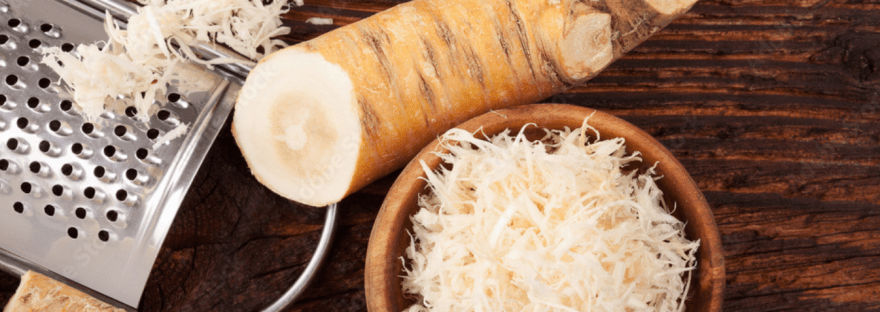
Prepared horseradish is made by peeling and grating the fresh horseradish root and storing it in vinegar, and salt. This is not the same as horseradish sauce which is widely seen on tables accompanying cuts of meat, poultry, or fish. On the contrary, horseradish sauce combines the prepared horseradish with cream, sour cream, or mayonnaise, which makes it much milder and creamier.
Once grated, the fresh horseradish can be kept in an airtight container or bag for around five to six days in the refrigerator, before it starts drying, or placed in the freezer for future use in dishes. The prepared horseradish, on the contrary, can be stored in an airtight container in the refrigerator for up to six weeks.
 QuIrKaLiCiOuS