FOOD

The history behind Horseradish

Legend has it the Delphic oracle told Apollo, 

“The radish is worth its weight in lead, the beet its weight in silver, and the horseradish its weight in gold.” 

There are very few things in this world that can beat the nasal-passage clearing, palate-rousing flavour of the knobbly root.

Whilst horseradish has been used worldwide for thousands of years, it is prized for its medicinal and gastronomic qualities, and bears a very intriguing history.

This root is a cruciferous vegetable, part of the Brassica genus of plants, alongside mustard, wasabi, cabbage, brussels sprouts, kale and more, and contains multiple compounds that may provide health benefits, including antibacterial and anticancer effects.

Horseradish has been used for centuries as an aphrodisiac, to treat rheumatism, and a flavourful accompaniment for most dishes.

So, how did the name ‘horseradish’ come about? Well, it is said that this perennial plant was cultivated in Greece and used both as a rub to treat lower back pain and as an aphrodisiac. From there it spread from east to west, with England being introduced to the root via Germany. The Germans called it “meerrettich” (sea radish) as it grew by the sea. It is believed that the English mispronounced the German word “meer”, and mistook the word to be a compound of the words “Mahre’ and “rettich”, meaning radish, and began calling it “mareradish.” As the German word “mahre“, is related to the English word “mare“, and both “rettich” and “radish” come from the Latin word “radix”, meaning root, eventually, it became known as horseradish. The word “horse” (as applied in “horseradish”) is believed to denote large size and coarseness.

When this root is cut, an enzyme breaks down a compound called sinigrin, a powerful antioxidant, into a mustard oil, giving horseradish its telltale odour and taste. This oil may have powerful antibacterial properties, with studies suggesting that it may fight a range of dangerous bacteria, including E. coliH. pylori, and Salmonella. It is also used for kidney stones and urinary tract infections.

Furthermore, it’s rich in a variety of healthy plant compounds, including glucosinolates, which break down into isothiocyanates and may protect against cancer, infections, and brain diseases.

So, you may recall us mentioning that horseradish is known for its nasal-passage clearing effect. For those of us that have eaten horseradish with a little too much zest, you will be well acquainted with the burning sensation experienced in your sinuses and throat, not to mention the tears that roll down your cheeks. For this reason, it is used to treat colds and breathing issues, alongside acute sinusitis and bronchitis.

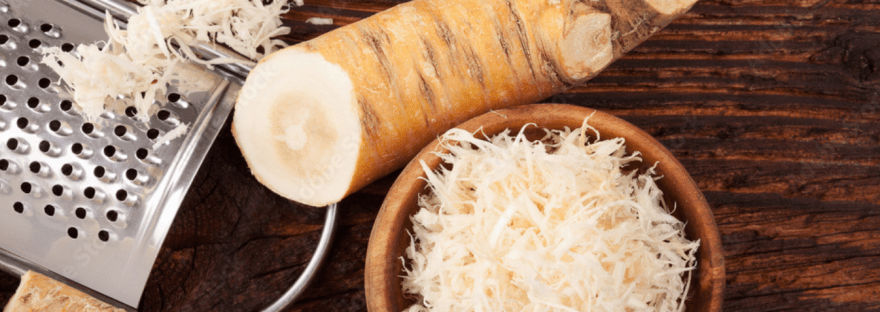
Prepared horseradish is made by peeling and grating the fresh horseradish root and storing it in vinegar, and salt. This is not the same as horseradish sauce which is widely seen on tables accompanying cuts of meat, poultry, or fish. On the contrary, horseradish sauce combines the prepared horseradish with cream, sour cream, or mayonnaise, which makes it much milder and creamier.

Once grated, the fresh horseradish can be kept in an airtight container or bag for around five to six days in the refrigerator, before it starts drying, or placed in the freezer for future use in dishes. The prepared horseradish, on the contrary, can be stored in an airtight container in the refrigerator for up to six weeks.

FOOD

Street Food…The Antidote To Fast Food.

Urbanisation and street food go hand in hand.

As people’s palate change, and we become receptive to a variety of different ingredients, flavours and cuisines, we are seeing an extraordinary leap in innovation concerning flavour combinations and the ways in which food is served.

The roots of street food date far back in history, to the birth of civilisation. In fact, it is believed that the first ever distribution of such street food began on the streets of Ancient Greece, with the sale of small fried fish. Having said this, there is an ongoing debate whether in fact it originated in Greece or whether its roots are in Asia, where it is more widely found. Regardless of this, the reason it transpired remains the same. It began as a way to cater for poor urban residents, whose tenement homes did not have ovens or hearths. And so provided nourishing dishes that were affordable by all.

Street food has evolved alongside civilisation, ever so discreetly. However, it’s most often out of poverty that the best of human ingenuity emerges, and so forth emerged the eternal recipes that would provide the foundations of an entire culinary culture.

So let’s take a minute to delve into a few different areas and their integration into street food… in Paris there were the “pâstés”; pastry cases with various fillings, usually stewed meat or vegetables. These then lead to the term “patisserie”. The anglo-saxon lower class also worked on the same principle of pies: a crust made of flour, lard and water containing a cooked filling, and in Britain, fish and chips were sold on the streets wrapped in newspaper.

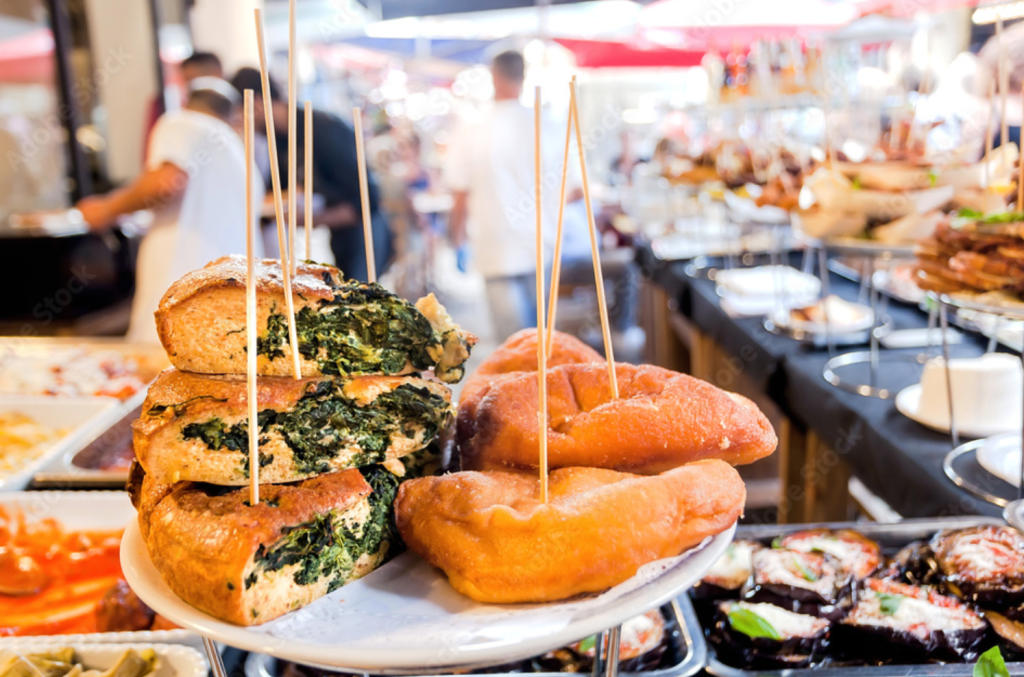
Spinach pie, grilled vegetables, and local street snacks in the stall of a traditional food market

Due to the fact that street food was born with the primary need to feed the poorer community, cheaply, it has always been considered of little worth. But this is far from the case. Street food is often the last defence for a place’s traditions and identity. It’s what identifies and distinguishes one area from another.

Those that have not been exposed to the street food culture tend to shy away from it thinking it is unhealthy and unhygienic. However, despite concerns about contamination at street food vendors, the incidence of contamination is very low with a number of studies showing rates comparable to those of restaurants.

Today, while some street foods remain regional, many are not, having spread wide and far.

So why do we love to eat fast food? Well, It’s economical, easily accessible, often nutritious, and offers an endless culinary variety of traditional dishes for every taste. Although we may recognise that the majority of street food is not extremely healthy, we love the fact that there are large varieties available at a cheaper price, and that the food is served ‘on the spot’. In most places, street food also represents the local cuisine, in a more authentic manner.

The contribution of street food vendors to the economy has been greatly underestimated and neglected, as is vital for the economic planning and development of many towns.

Remember:

It’s fast food, NOT junk food.

It’s a way of life!

MENTAL HEATLH

The concept of Time

Time is the most undefinable yet paradoxical of things; the past is gone, the future is not come, and the present becomes the past, even while we attempt to define it. Charles Caleb Colton (1824).

Our lives consist of an infinite number of variables. In fact, it might even be safe to say that our lives are one big variable. Time is a variable, health another, even our moods are variables. There comes a point where we begin to wonder if there actually is anything we control in our lives… the people we fall in love with, our emotions, our reactions are yet more examples of things we can’t control.

So what is the definition of a variable? A variable is something that is not consistent or has a fixed pattern; it’s liable to change and adapt.

We walk around believing and claiming that we have all the time in the world to do this, and that, and everything under the sun, but is that really true? Time is an uncertainty. Are we able to control it? No we aren’t. Time is limited and can change at the drop of a hat. So what I say is; live your life and make every second count. Tell those you love how you feel, what they mean to you, and try to spend as much time as you can with them. Don’t take it for granted that they will be around forever for you to lose that valuable minute not telling them you love them, admire them, or even what traits it is that you admire and look up to. Because if you were to lose that crucial minute and have the opportunity to tell them taken away from you, what would you do? How would you feel?

Would you say you feel depressed? When people feel great sadness, grief or bereavement, they instantly associate it with depression but in truth, they are not one of the same. The loss of a job, the death of a loved one, or the ending of a relationship are all difficult experiences for a person to endure, and therefore normal to develop feelings of sadness or grief in response to such situations. But being sad is not the same as being depressed. You see, the grieving process is natural and unique to each individual. Although it does share a few features of depression, it also differs in other very significant ways. For example, 1) when experiencing grief, the painful feelings tend to come in waves, often intermixed with more positive memories. With depression, mood, interest and/or pleasure are decreased for the majority of two weeks. *Note that for a diagnosis of depression to occur, the symptoms must last a period of at least two weeks consecutively. 2) in grief, self-esteem is usually maintained whereas in depression, feelings of worthlessness and self-loathing are commonly present. And 3) in grief, thoughts of death may arise when thinking about “joining” their deceased loved one, whereas with depression, their thoughts are focused on ending their lives due to feeling worthless, undeserving of living, or being unable to cope with the pain of depression.

Having said that, grief and depression are able to co-exist. For some, the grief caused by the death of a loved one, the loss of a job, or being the victim of a physical assault/domestic violence or a major disaster can lead to depression. When grief and depression co-occur, the grief experienced is more severe and lasts longer.

Several factors that play a role in depression are; biochemistry, genetics, personality, and environmental factors. In reference to environmental factors, we are referring to situations such as continuous exposure to violence, neglect, abuse or poverty.

There are a number of medical conditions that can mimic symptoms of depression as well, such as thyroid problems, vitamin deficiencies or even a brain tumour. It is therefore of upmost importance that these are ruled out first.

So, to sum things up, don’t let a minute go by without telling those you love how you feel about them and what they mean to you, telling your friends what you like and admire about them, giving your family members that long heart-warming embrace and generally spending time with those that mean something to you.

Depression can affect anyone, even those who appear (externally) happy and in ideal living circumstances….you see, those that smile the most hide the greatest pain.

So make sure to take time to smile, talk, lend an ear, and always be nice, because you don’t know what might be happening in someone’s life, or what is going on behind the scenes. You may be just the person they need to help them get out of a terrible situation.

Life is all about making moments and memories. So let’s go do just that!